
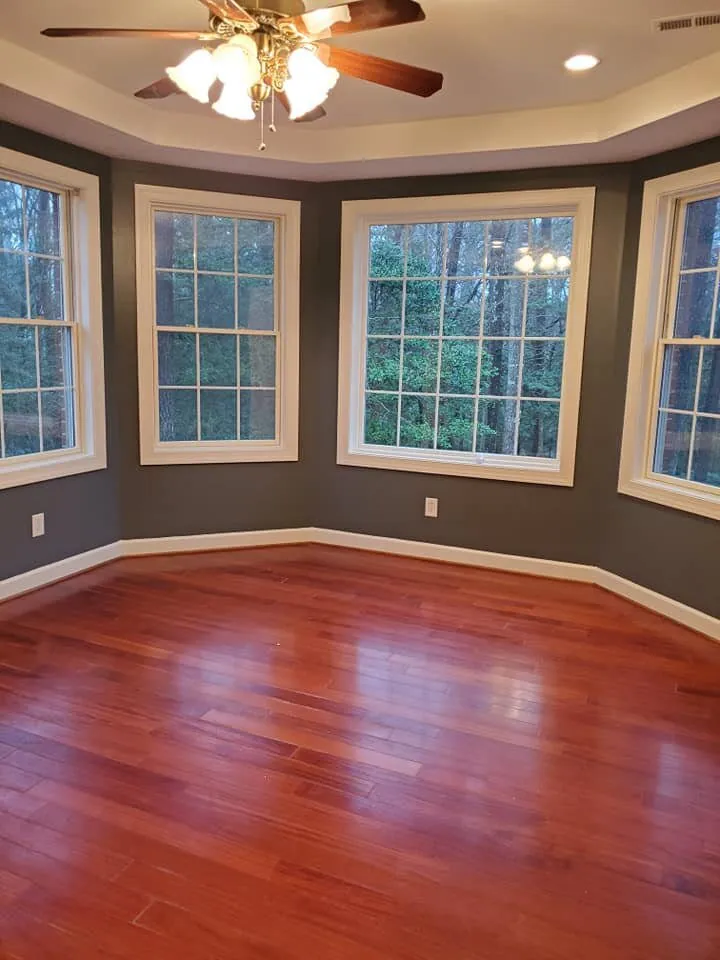
Every repaint bid you get is really two bids stacked on top of each other: the preparation, and the number of coats. Most homeowners look hard at the first number and skim past the second, because "two coats" sounds like an upsell.
It is not an upsell. It is a different product.
What one coat actually does
One coat covers. Stand in the room on the day it is finished and you will not see the old color through it. That is the entire case for a single-coat job and it is genuinely true for about a year.
What one coat does not do is build an even film. Paint does not go on at a perfectly uniform thickness. A roller carries more in the middle of a pass and less at the end of it, a brush loads heavier at the start of a stroke, and a wall that has been patched has patches that drink more than the sound drywall around them. On a single coat those differences stay exactly where they landed.
You cannot see them at first because the color is fresh and uniform. You see them later, and you see them in three specific ways.
The three ways it gives itself away
The old color pushes back through. This is worst on a wall taking direct sun, so on this coast it is the south and west walls of a room and the elevation facing the water outside. Ultraviolet works on the film, the film thins where it was already thin, and the previous color starts reading through as a shadow. On a color change it is obvious. On white over an older, yellowed white it shows up as a wall that looks dirty in the corners and clean in the middle.
The sheen goes uneven. Sheen comes from the resin at the surface of the film. Where the film is thin, more of the surface is the underlying wall and less of it is resin, so those areas go flatter than the rest. In raking light down a hallway or across a long open-plan wall, this reads as stripes. It is the single most common thing people call us about a year after somebody else painted.
It fails first where it was thinnest. Cut lines at the ceiling, the last foot of every roller pass, and the inside corners. Those are the hardest places to get a consistent load and the places a single coat is always thinnest.
Why the second coat is not just more paint
Here is the part that gets missed. The second coat is not doing the same job as the first one.
The first coat seals the surface and evens out whatever the primer left behind. Patched drywall, old paint of different ages, a bit of chalk, a spot that was sanded harder than the area next to it — after the first coat, all of that is one surface with one porosity.
The second coat then goes down onto something uniform. That is why it lays out evenly, why the color reads the same in the corner as it does in the middle of the wall, and why the sheen is consistent when the light rakes across it.
Two thin coats and one thick coat are not the same thing either. A single heavy coat sags, takes far longer to cure properly, and cures unevenly through its thickness. Two coats at the right film build, each allowed to cure, is a harder and more uniform finish than the same volume of paint applied at once.
What this coast adds to the problem
Hampton Roads is humid for most of the year, and humidity slows curing. A coat that is dry to the touch on a July afternoon in Chesapeake can still be soft underneath. Put a second coat on it too early and you trap the first one, which is its own failure and a slower one to show up.
Outside, salt aerosol coming off the Bay and the ocean lands on every exterior surface, holds moisture against the film, and works at anything already thin. A single-coat exterior on a water-facing elevation in Norfolk or at the North End is not being asked to last ten years. It is being asked to last through the first three winters, and it usually does not.
The honest trade
Two coats takes longer and it costs more to put on. There is no version of this where it does not. What you get for it is a finish that still looks like paint and not like a touch-up in year four, on the walls you look at every day.
That is what the name is pointing at. Every surface in the scope gets two full coats, over a surface that has already been patched, caulked, sanded and primed where it needed it. It is not an option on the quote. It is the quote.