
Kitchens, Hampton Roads
Cabinet refinishing
Keep the boxes. Keep the layout. Lose the forty-year-old finish.
A kitchen dates faster than any other room in a house, and almost all of that is the color of the cabinet doors. The boxes are usually fine. The hinges are usually fine. The layout is the layout you already live with and mostly like. What has aged is a finish that was applied in a factory a long time ago and has been cleaned with degreaser twice a week ever since.
Refinishing changes the finish and keeps everything else. It costs a fraction of replacement, it takes days instead of weeks, and you keep joinery that in a lot of Hampton Roads houses is better than what you would get new.
It is also the least forgiving painting job there is. A cabinet door is touched, wiped, knocked and opened thousands of times a year, at eye level, in the best-lit room in the house. There is nowhere to hide a shortcut.
Free estimate
Book a walkthrough for cabinet refinishing
Pick a time and it is confirmed there and then. Nate comes out, looks at the actual surfaces, and tells you honestly whether this is the right job for your house.
Would rather talk? (757) 288-1905
Step 1
Pick a slot
Nate’s real calendar, showing the times that are actually free. It works at eleven at night, which is when most people think about this.
Step 2
It is confirmed there and then
No waiting to hear back, and no phone tag to find an hour that works for both of you.
Step 3
He does the walkthrough himself
Nate looks at the actual surfaces rather than the square footage — what is peeling, what is bare, what has been patched before.
Step 4
You get it in writing
A written scope saying what is included and what is not, and a number to go with it. Free, with no obligation attached.
Drag it
Same boxes. Same hinges.
The granite did not change. The backsplash did not change. The layout did not change. What changed is the finish on the doors, and it is the thing that was making the room look its age.
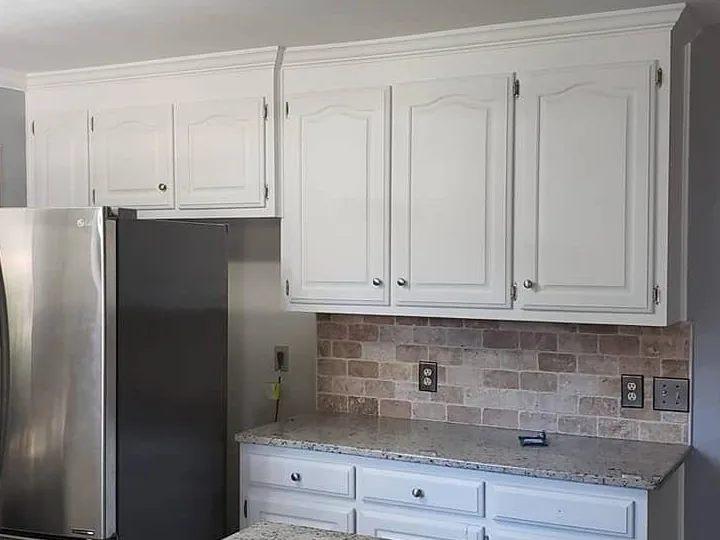
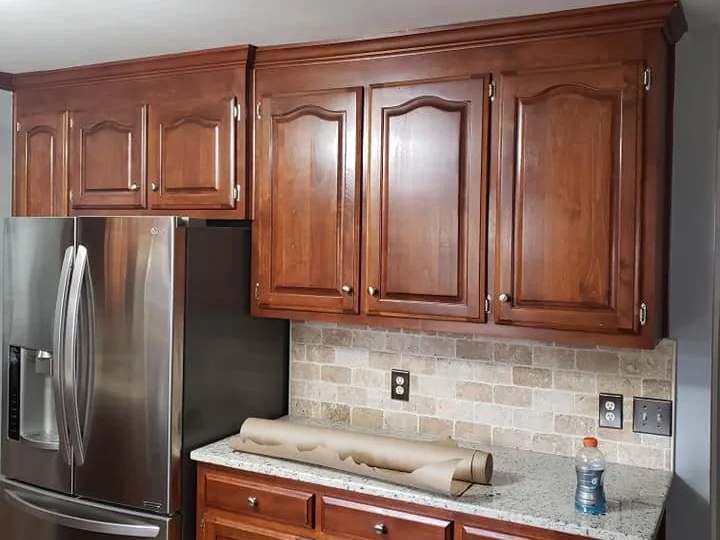 BeforeAfter
Step by step
How a cabinet refinishing job runs
- 01
Walkthrough and labeling
Nate looks at the boxes, the doors, the hinges and the existing finish, and tells you honestly whether refinishing is the right call. Not every kitchen is. Then every door and drawer front gets numbered and its position recorded, because doors are not interchangeable and a door hung in the wrong opening never quite closes right again.
- 02
Doors come off, kitchen gets sealed
Doors, drawer fronts and hardware come off and move to a masked-off spray area set up at your house — the garage, a covered porch, wherever there is room and control. Nothing leaves for a shop. Counters, appliances, floors and openings get masked and covered. You keep the use of your sink and your refrigerator through the job.
- 03
Degrease, then abrade
Kitchen cabinets carry cooking grease, and no primer bonds to grease. Everything gets degreased first, then scuff-sanded so the surface has a mechanical key. Skipping either one is the single most common reason a refinished kitchen starts chipping at the door edges within a year.
- 04
Fill, sand, prime
Dings and old hardware holes get filled and sanded flush. Then a bonding primer that is made for this, not a general wall primer. On stained oak and other open-grain woods the grain telegraphs through a light color unless it is dealt with at this stage, which is a conversation to have before you choose white.
- 05
Finish coats, with real cure time between
Doors and drawer fronts are sprayed flat, both faces, edges included, in the area set up for it at your house. Spraying is what puts an even film on a flat panel without leaving brush ridges down it. Boxes get finished in place. Then everything cures properly before the next coat, and again before anything is handled. Rushing the cure is how you get a finish that looks perfect on day one and prints a fingerprint on day three.
- 06
Rehang, adjust, walk it
Every door goes back in the opening it came out of, gets adjusted so the reveals are even and the doors line up, and gets new bumpers. Then we walk the kitchen with you and a light, and anything you point at gets fixed before the crew loads out.
Why the film has to be even, not just clean
A cabinet door is a flat panel at eye level in the brightest room in the house, with light raking across it from a window and from under-cabinet fixtures at the same time. Texture that would be invisible on a wall, and is often desirable there, reads as stripes and orange peel from the doorway on a door.
Texture is a durability problem as well as a cosmetic one. A stippled surface has more surface area and more micro-edges, it holds grease and grime in the low spots, and it wears at the high spots first. What you want on something wiped down constantly is a thin, even, continuous film.
It matters most at the door edges and in the profile of a raised or shaker panel, where film build is hardest to keep consistent. That is the case for spraying the doors: a sprayed film lays into a shaker profile evenly instead of pooling in the inside corner the way a loaded brush does. Those inside corners are where a cabinet finish starts to fail, and they are the first place anyone looks.
What actually makes a cabinet job last
Three things, and none of them are the brand of paint on the can.
Degreasing, because a cabinet in a working kitchen is coated in an invisible film that no primer will stick through. Abrasion, because a factory finish is designed to be smooth and non-porous and a new coat needs a key to hold onto. And cure time, because cabinet coatings reach full hardness days after they are dry to the touch, and a door that is handled and closed against a frame before it has hardened will carry that mark permanently.
A kitchen that fails does not usually fail across the whole face of a door. It fails at the edges, around the handle, and at the top of the drawer front under the counter overhang. Those are the places grease sits and the places a hand touches. They are also the places a fast job skips.
What refinishing will not fix
Refinishing changes the finish. It does not change the layout, it does not make a small kitchen bigger, and it does not repair boxes whose bottoms have swelled from a slow leak under the sink. If your doors are delaminating thermofoil or your boxes are failing, refinishing is not the answer and we will tell you that at the walkthrough rather than after the deposit.
Open-grain woods deserve their own warning. Oak has a strong grain pattern, and under a light solid color that pattern still reads through the finish. Some people want that and it looks good. Some people expect a smooth modern door and are disappointed. It is a decision to make before work starts, not a surprise at the end.
“Nate and his crew did a great job! They are thorough and professional. I highly recommend them for any painting project you have.”
“5 thumbs up! Very impressed with the superior quality of work!”
Cabinet Refinishing questions
Cabinet Refinishing, answered
How long does cabinet refinishing take?
Several days for a typical kitchen, and the length is driven by cure time rather than by painting time. The doors have to harden between coats and again before they are rehung. A schedule that promises it in a day is skipping that.
Can I use my kitchen while the work is happening?
Yes. The doors come off and the boxes are finished in place, so you keep the sink, the refrigerator and the counters. You will be without cabinet doors for a few days.
Do you spray the doors, or brush them?
Doors and drawer fronts are sprayed. It is the reliable way to get an even film across a flat panel and into the profile of a shaker or raised door without leaving brush ridges down the face of something you look at every day.
Do my cabinets have to leave the house?
No. All of it happens at your house. The doors and drawer fronts come off and move to a masked-off area set up on site — usually the garage or a covered space — and the boxes are finished where they are. Nothing goes to a shop and nothing comes back on a truck weeks later.
Can oak cabinets be painted white?
Yes, and the grain will still read through the finish. That is a look some people want. If you are expecting a smooth modern door, oak grain has to be filled at the preparation stage, and that is a decision to make before work starts.
Do you replace the hinges and handles?
Hardware comes off and goes back on. If you want different handles or hinges it is the ideal moment to change them, since everything is already off and the holes can be filled and re-drilled while the doors are being prepared.
Is refinishing cheaper than new cabinets?
Considerably, and it is faster. You keep the boxes, the layout and the joinery, and change the part that actually dates the kitchen. Whether it is the right call depends on the condition of your boxes, which is what the walkthrough is for.
Will the finish chip?
Not if it was degreased, abraded, primed with a bonding primer and allowed to cure. Cabinets that chip at the door edges within a year were almost always painted over grease or handled before the coating hardened.
Ask Nate about cabinet refinishing
Pick a time that suits you and the slot is confirmed there and then, at eleven at night if that is when you are thinking about it. Nate comes out, looks at what is actually there, writes down what he would do, and gives you a number.