
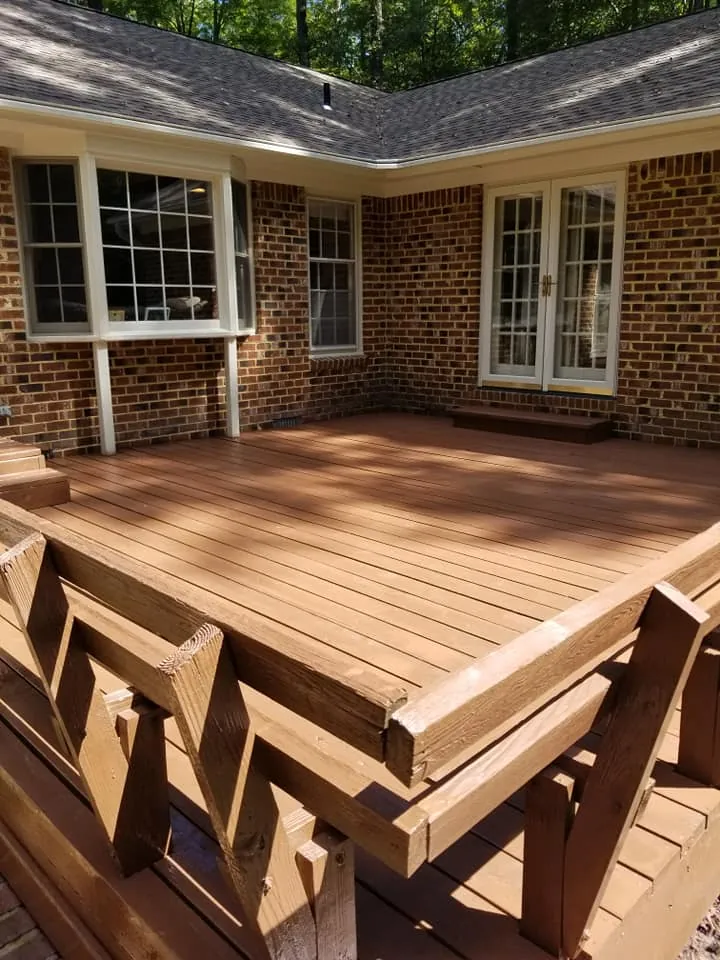
People ask what paint we use. Almost nobody asks what day we are putting it on, and the day matters more.
An exterior coat has a window between going on and setting up during which it is vulnerable to almost everything: pollen, dew, direct heat, wind-blown grit. Get that window right and an ordinary coating performs. Get it wrong and the best product on the shelf will not save it.
Here is the year, as it actually runs on this coast.
Late March to mid-May: pollen
Spring in Hampton Roads is heavy. Oak and pine drop enough that cars go yellow-green overnight and you can see the pollen line on a puddle. That same film lands on a wall that was painted four hours ago and has not set.
It does not wash off later. It is in the film.
This does not make spring unpaintable, and plenty of good work gets done in April. It does mean the house has to be washed immediately before work rather than the week before, that we watch the count, and that some jobs are better pushed three weeks than started on the worst fortnight of the season.
Mid-May to late June: the first good window
This is the best stretch of the year. Long days, warm but not brutal, dew points that behave, and the heaviest pollen has dropped.
Walls are warm enough for good film formation and not so hot that the coat skins before it has flowed out. This is when we would like to be painting your house.
July and August: heat on the wrong wall
The problem in deep summer is not air temperature, it is surface temperature. A south or west elevation in full afternoon sun in Virginia Beach gets far hotter than the air around it, hot enough to shorten a coating's open time significantly.
When open time drops, the wet edge you are working to closes before you get back to it, and the next pass lands on paint that has already started to set. That is a lap mark, and it is permanent. It shows up as a visible band across the wall in raking light, on a wall that was rolled perfectly competently.
The answer is to follow the shade around the house rather than work in a straight line: start on the elevation that is out of the sun and move as the sun does. It is slower and it is the difference between a wall that looks even and one that does not.
Summer humidity is the other half of it. High humidity slows the cure, so a coat that is dry to the touch may still be soft. A second coat over a first that has not cured traps it.
September to early November: the second good window
The other good stretch, and often the better of the two. Heat has come out of the walls, humidity has eased, and there is enough day left for a coat to set before the evening damp arrives.
The thing to watch in autumn is the dew point rather than the forecast. A clear night with a dew point close to the air temperature leaves a film of moisture on the siding that does not burn off until mid-morning. Painting into that is painting onto a damp wall.
Mid-November onward: mostly no
Cure time depends on temperature, and most exterior coatings have a minimum surface temperature well above freezing. Air at 55 degrees at two in the afternoon does not mean the north wall of your house is at 55. Once the wall drops below what the product needs, the film does not form properly, and the failure will not show until the following summer.
There are warm, dry stretches in November and even December where a south elevation is fine. They are worth taking. They are not worth assuming.
The short version
Aim for May into June, or September into early November. Expect us to say so if your job wants to wait three weeks for a better window.
Painting on the wrong day to hit a date on a calendar is the most reliable way to turn a ten-year job into a four-year one, and by the time anyone can see it, the crew is long gone.