
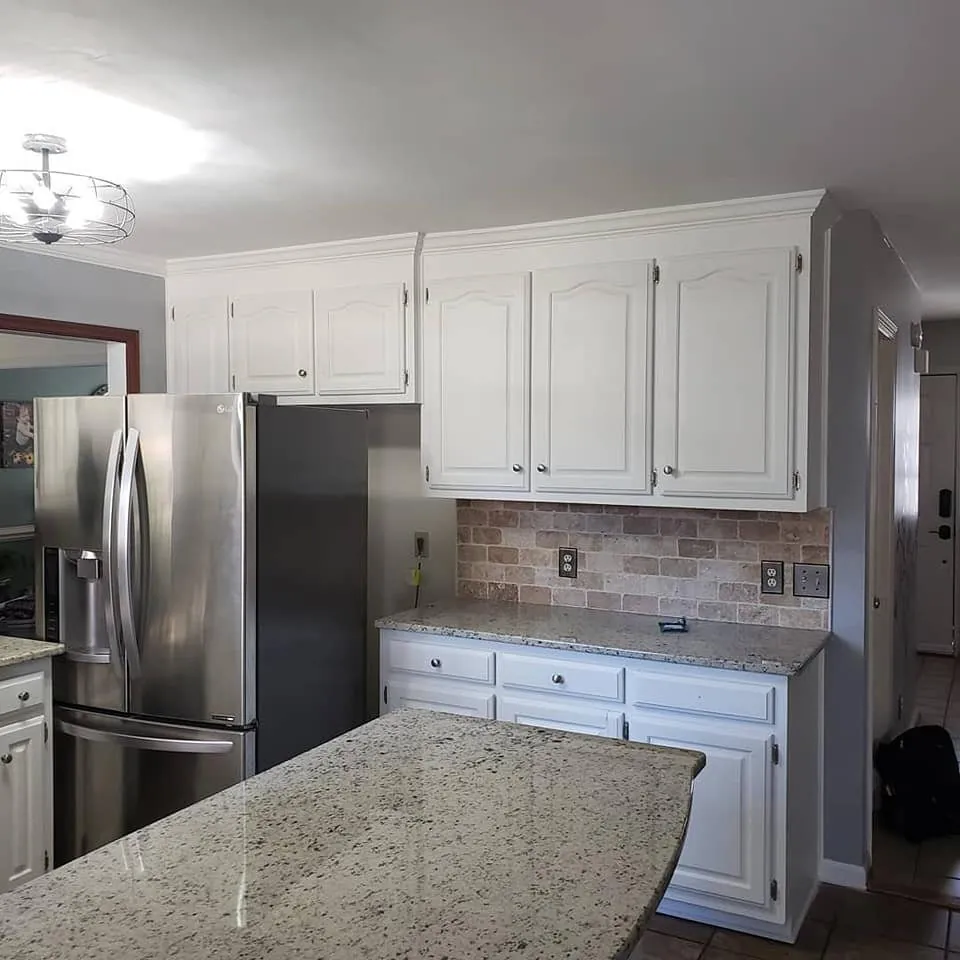
Refinishing a kitchen is one of the highest-return things you can do to a house. It changes the room that dates the whole place, it costs a fraction of replacement, and it takes days instead of weeks.
It is also the wrong answer for some kitchens, and it is worth knowing which before anyone quotes you.
Open a door and take five minutes with this list.
1. Are the boxes sound?
Pull everything out from under the sink and look at the cabinet floor and the back corners. A slow supply leak or a dripping trap swells particleboard from the inside, and once a box bottom has swelled it does not come back. Push a thumbnail into it. If it gives like cork, that box needs work no finish will hide.
Then check the face frames and the joints where the boxes meet each other. Slight racking is normal in an older kitchen. Joints you can move with your hand are not.
If the boxes are sound, everything else on this list is fixable.
2. What are the doors actually made of?
This is the one that decides it.
Solid wood doors, and plywood or MDF doors with a painted or stained finish, refinish beautifully. Most kitchens in Hampton Roads built from the seventies through the early two-thousands are exactly this, and a lot of them have better joinery than anything at the same price today.
Thermofoil is different. It is a vinyl film heat-wrapped over MDF, and it is common in kitchens from the late nineties onwards. Look at the inside face of a door, especially near the oven or the dishwasher. If the film is lifting, bubbling or peeling at an edge or a corner, that door cannot be refinished into a good result. The film has to come off or the door has to be replaced, and once you are replacing doors you are into a different project.
Laminate over particleboard has the same problem for the same reason.
3. Is the grain going to show?
Oak was the default cabinet wood in this region for decades, and oak has an open, strongly figured grain. Paint it a light solid color and that grain still reads through the finish. There is no way around it short of filling the grain at the preparation stage, which is real extra work.
Some people love it — it looks like a painted wood kitchen because it is one. Some people are picturing a smooth modern shaker door and are quietly disappointed on the day.
Decide which one you are before work starts, not after.
4. How bad is the grease, honestly?
Every working kitchen builds a film of cooking grease on the cabinet fronts, worst above and beside the range and on the doors nearest it. You cannot see it. Wipe a finger across the door above your cooktop and then across a door at the far end of the run, and you can feel it.
Grease is not a reason to skip refinishing. It is a reason to be suspicious of a quote that does not mention degreasing. No primer bonds through grease. A kitchen that starts chipping at the door edges within a year was almost always painted over a film that was never removed.
5. Do you actually like the layout?
The unglamorous one, and the one worth sitting with. Refinishing changes the finish. It will not move the dishwasher, it will not give you a pantry, and it will not make a galley kitchen wider.
If the layout is the problem, spending money on the finish is spending money in the wrong place. If the layout is fine and the finish is tired — which is the situation in most of the kitchens we look at — refinishing is the obvious answer.
What a real answer looks like
At the walkthrough, the boxes get looked at, the doors get identified, the grain gets discussed and the grease gets acknowledged. If refinishing is not right for your kitchen, you get told that then, rather than after a deposit.
Two of the five things above are genuine deal-breakers: failing boxes and lifting thermofoil. The other three are decisions to make with your eyes open.